

AI in Electroplating: How Data-Driven Technology Can Improve Gold, Silver, Nickel & Copper Finishes
Electroplating has always been a process where precision, consistency, and process control matter. Small changes in bath chemistry, temperature, current density, pH, plating time, or surface preparation can affect the final appearance and performance of a coating. Traditionally, experienced operators and engineers have relied on process measurements, laboratory testing, and visual inspection to maintain quality.
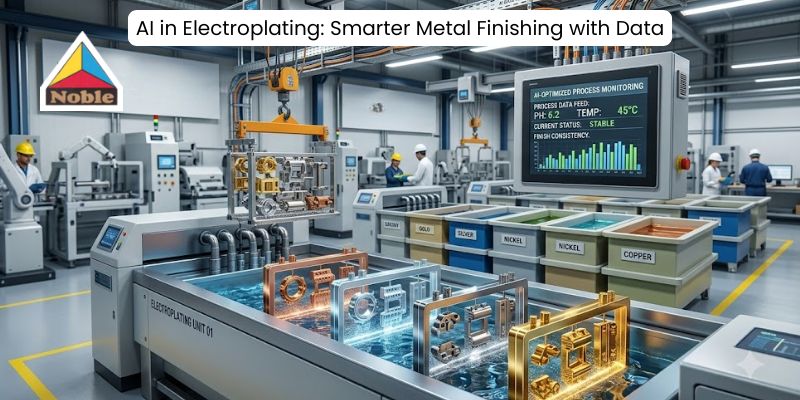
Today, Artificial Intelligence (AI), machine learning, sensors, computer vision, and data analytics are creating new possibilities for electroplating operations. By collecting and analyzing production data, manufacturers can identify patterns, detect abnormalities, predict potential defects, and make better-informed process decisions.
How AI Is Changing Electroplating
A modern electroplating line can generate large amounts of information. Data may come from rectifiers, plating tanks, temperature sensors, pH meters, chemical analysis, coating-thickness measurements, production records, and quality inspections.
AI can analyze these variables together rather than treating them as isolated measurements. For example, a manufacturer may discover that a particular combination of temperature, current density, chemical concentration, and plating time is frequently associated with surface defects.
This creates a shift from reactive quality control to predictive process management. Instead of discovering a problem only after a batch has been completed, manufacturers can potentially identify unusual process conditions while production is still underway.
Improving Gold Electroplating With Data
Gold plating is used in applications where corrosion resistance, electrical conductivity, reliability, and appearance are important. Because gold is also a valuable material, controlling coating thickness and minimizing unnecessary deposition can have a direct impact on production costs.
AI systems can analyze gold concentration, current density, plating duration, temperature, part geometry, and historical thickness measurements. Over time, these datasets can help identify operating conditions that consistently produce the required finish.
Data analysis can also help manufacturers identify patterns of over-plating or inconsistent deposition. Rather than relying only on fixed process settings, production teams can use historical results to better understand how changes in operating conditions affect gold consumption and coating quality.
Making Silver Plating More Consistent
Silver electroplating is widely used for its electrical and thermal conductivity, solderability, and appearance. Maintaining consistent silver finishes requires control over bath chemistry, current distribution, substrate preparation, and other process conditions.
AI can compare current production data with previous batches that achieved acceptable results. If the system detects an unusual combination of parameters, it can flag the condition for investigation before the finished parts move further through production.
This approach can be particularly useful when several variables change at the same time. Instead of checking every parameter independently, machine-learning models can identify relationships between multiple process variables and historical quality results.
AI Applications in Nickel Electroplating
Nickel plating is commonly used to provide corrosion resistance, wear resistance, hardness, and decorative appearance. Maintaining a consistent nickel finish can involve controlling factors such as temperature, pH, nickel concentration, current density, agitation, additives, and plating time.
AI can help analyze these factors alongside historical inspection data. For instance, if surface roughness begins increasing, a data-driven system can compare the current conditions with previous batches where similar defects occurred.
The goal is not to replace chemical analysis or the experience of plating professionals. Instead, AI can provide another layer of information that helps engineers investigate problems more quickly and identify recurring process patterns.
Optimizing Copper Electroplating
Copper electroplating is important in electronics, printed circuit boards, electrical components, connectors, automotive parts, and industrial applications. One of the challenges in copper plating is achieving consistent deposition across different areas of a component.
Part geometry can influence current distribution, which can result in variations in coating thickness. By combining thickness measurements with electrical and process data, AI models can help identify patterns associated with uneven deposition.
This information can support improvements in process settings, fixture design, and production controls. In high-volume manufacturing, even small improvements in deposition consistency can become significant when repeated across thousands of components.
Computer Vision for Plating Inspection
AI can also improve the way finished surfaces are inspected. Computer vision systems can use cameras and image-analysis algorithms to identify visible characteristics such as discoloration, stains, scratches, pitting, and surface irregularities.
Instead of relying entirely on manual inspection, manufacturers can use automated vision systems to screen components and flag parts that require further examination. Human inspectors can then focus on complex or uncertain cases.
This creates a practical combination of automation and human expertise, rather than treating AI as a complete replacement for quality-control personnel.
Predictive Maintenance and Bath Management
AI can also be applied beyond the plating chemistry itself. Equipment such as rectifiers, pumps, filtration systems, temperature controllers, and agitation systems can influence production quality.
By monitoring equipment performance over time, AI-based predictive-maintenance systems can identify unusual patterns that may indicate developing problems. Maintenance teams can then investigate equipment before a failure causes unexpected downtime or affects an entire production batch.
Similarly, historical bath-analysis data can help manufacturers understand chemical consumption and replenishment patterns. This can support more controlled chemical management instead of relying solely on fixed replenishment schedules.
Why Data Quality Matters
Successful AI implementation starts with reliable data. If production records are incomplete, inconsistent, or inaccurate, an AI system may produce unreliable insights.
Manufacturers therefore need standardized methods for recording bath conditions, chemical additions, electrical parameters, inspection results, coating thickness, defects, and equipment performance. The better the historical data, the more useful AI-based analysis can become.
Most importantly, AI should work alongside electroplating knowledge and engineering expertise. Experienced professionals understand factors that may not always appear in a dataset, including substrate conditions, fixture issues, unusual bath behavior, and practical production constraints.
AI Does Not Replace Electroplating Expertise
There is an important distinction between AI-assisted electroplating and fully autonomous electroplating.
AI can identify correlations and patterns, but experienced plating professionals understand factors that may not be captured in a dataset.
An experienced operator may recognize:
- A change in solution appearance
- Unusual equipment behavior
- Fixture problems
- Substrate-related issues
- Chemical interactions
- Maintenance history
- Process conditions that look normal numerically but unusual operationally
The strongest model is therefore likely to combine:
Human expertise + Electrochemistry + Process engineering + Machine learning + Real-time data
AI should be viewed as a decision-support tool rather than a replacement for technical expertise.
Challenges of Implementing AI in Electroplating
Although the potential is significant, implementation comes with challenges.
1. Data Collection
Many plating facilities still rely partly on manual records. Moving toward AI requires consistent digital data collection.
2. Sensor Reliability
Sensors must remain accurate in demanding industrial environments. Incorrect sensor readings can lead to incorrect conclusions.
3. Integration With Existing Equipment
Older plating lines may not have modern connectivity or automated monitoring capabilities. Connecting legacy equipment to modern data systems can require additional investment.
4. Training and Expertise
Teams need to understand both the plating process and the interpretation of data. AI tools should therefore complement—not bypass—existing technical knowledge.
5. Cybersecurity and Data Governance
Connected manufacturing systems create additional requirements for protecting production data and controlling access to industrial systems.
Conclusion
The future of electroplating is likely to involve increasingly connected production environments where sensors, automation, machine vision, data analytics, and AI work together.
A smart plating operation could continuously collect process information, compare it with historical quality data, identify abnormal conditions, and alert operators when a process begins moving outside its established range.
The fundamental chemistry of electroplating will not disappear. Instead, AI can provide manufacturers with a more powerful way to understand that chemistry in relation to real-world production data.
For gold, silver, nickel, and copper finishes, the opportunity is ultimately about moving toward more predictable quality, better process visibility, reduced waste, and smarter decision-making. As the metal-finishing industry continues to adopt Industry 4.0 technologies, data-driven electroplating could become an increasingly important part of modern surface-finishing operations.