
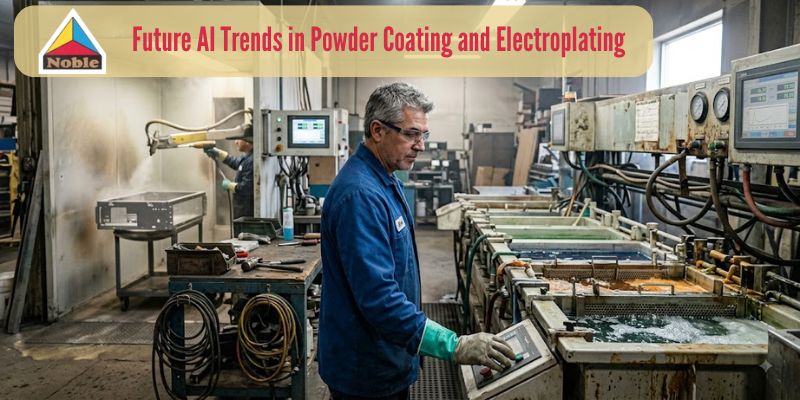

Future AI Trends in Powder Coating and Electroplating Every Manufacturer Should Know
Powder coating and electroplating have traditionally depended on skilled operators, carefully controlled process parameters, and manual quality inspections. But as manufacturers demand greater consistency, lower waste, faster production, and stronger environmental performance, artificial intelligence is becoming an important part of the next generation of surface finishing.
AI can analyze production data, identify process patterns, predict equipment problems, and support real-time quality control. Industry sources already point to AI-driven process optimization, predictive maintenance, computer vision, and connected coating systems as important developments for modern finishing operations.
So, what will AI look like in powder coating and electroplating over the coming years?
Here are the key trends manufacturers should watch.
AI-Powered Process Optimization
One of the biggest opportunities for AI is real-time process optimization.
Both powder coating and electroplating involve multiple variables that can affect the final finish.
For powder coating, these may include:
- Powder application
- Spray pressure
- Temperature
- Conveyor speed
- Curing time
- Coating thickness
- Humidity
In electroplating, variables can include:
- Bath chemistry
- Temperature
- Current density
- Plating time
- Chemical concentration
- Coating thickness
AI can analyze these variables alongside historical production data to identify combinations that produce more consistent results.
Instead of relying entirely on manual adjustments, manufacturers can move toward data-driven process control.
AI-Powered Quality Inspection
Quality inspection is another area where AI is likely to have a major impact.
Computer vision systems can use cameras and machine learning to inspect coated or plated components for defects.
For powder coating, AI-powered inspection could identify:
- Scratches
- Pinholes
- Orange peel
- Blisters
- Uneven coating
- Discoloration
- Surface contamination
For electroplating, AI can help identify issues such as inconsistent appearance, surface defects, pitting, or abnormal coating distribution.
Unlike manual inspection, automated vision systems can continuously inspect production without becoming fatigued. This creates an opportunity for manufacturers to detect defects earlier and improve consistency.
Predictive Maintenance for Coating Equipment
Unexpected equipment failure can disrupt an entire finishing operation.
AI can help manufacturers move from reactive maintenance to predictive maintenance.
Sensors can collect information from pumps, spray equipment, ovens, conveyors, rectifiers, motors, and other critical equipment.
AI can then analyze changes in:
- Temperature
- Vibration
- Energy consumption
- Pressure
- Operating cycles
- Equipment performance
If the system detects an unusual pattern, maintenance teams can investigate before a major breakdown occurs.
This can reduce unplanned downtime, improve equipment utilization, and extend the useful life of manufacturing assets.
Smart Powder Coating Systems
Powder coating operations are increasingly becoming connected through Industry 4.0 and IIoT technologies.
Modern systems can collect production information and use software to monitor coating performance, powder consumption, equipment settings, and process conditions.
The next step is combining these connected systems with AI.
AI could help manufacturers determine how different operating conditions affect powder usage and coating quality, while automated systems can use those insights to improve production.
Emerging digital technologies are already being used to fine-tune powder coating operations and improve material efficiency.
Smarter Electroplating Through Data Analytics
Electroplating is highly dependent on maintaining the right process conditions.
Small changes in bath chemistry, temperature, current density, or plating time can affect the final result.
AI can bring together data from sensors, laboratory testing, production records, and previous batches to identify patterns.
Over time, manufacturers could use these models to:
- Predict coating quality
- Identify process deviations
- Optimize bath conditions
- Reduce rejected parts
- Improve consistency
- Support faster troubleshooting
This could make electroplating operations less dependent on trial-and-error adjustments.
Digital Twins for Surface Finishing
Digital twins are another technology worth watching.
A digital twin creates a virtual representation of a physical process or production system. Manufacturers can use simulations to understand how changing certain parameters may affect production.
For coating and plating operations, digital twins could eventually help manufacturers test:
- New process parameters
- Production speeds
- Equipment configurations
- Curing conditions
- Material changes
- Maintenance scenarios
Instead of experimenting directly on a production line, manufacturers could evaluate different scenarios digitally before implementing changes.
AI for Sustainability and Waste Reduction
Sustainability will become increasingly important for manufacturers.
AI can support sustainability by identifying opportunities to reduce:
- Powder waste
- Chemical consumption
- Energy usage
- Water consumption
- Rework
- Production scrap
For example, AI could analyze curing conditions and production data to identify opportunities for reducing unnecessary energy consumption while maintaining coating quality.
In electroplating, AI-enabled monitoring can also support better process control and wastewater management.
The metal finishing industry is already looking toward AI and advanced technologies to improve environmental performance and respond to increasingly demanding sustainability requirements.
AI Will Assist Operators—Not Simply Replace Them
One misconception about industrial AI is that it will eliminate the need for skilled workers.
In reality, the more likely direction is human-AI collaboration.
Experienced operators understand chemistry, equipment behavior, materials, and real-world production challenges. AI can process large amounts of data and identify patterns much faster.
Together, they can make better decisions.
An operator may receive an AI-generated alert that a coating parameter is moving outside its normal range. Instead of waiting until a batch fails inspection, the operator can investigate and make an informed adjustment.
The combination of human expertise + AI intelligence could become one of the strongest advantages for modern finishing facilities.
What Manufacturers Should Do Now
Manufacturers don’t need to completely automate their powder coating or electroplating operations immediately.
A practical starting point is to identify one problem where AI could create measurable value.
For example:
- Identify a recurring quality problem.
- Start collecting reliable production data.
- Install appropriate sensors or monitoring systems.
- Digitize inspection records.
- Explore AI-based quality inspection.
- Test predictive maintenance on critical equipment.
- Measure improvements in waste, downtime, quality, and energy consumption.
- Expand successful applications gradually.
The quality of the underlying data is critical. AI systems perform much better when manufacturers have accurate, well-organized production information.
Conclusion: The Future of Surface Finishing Is Intelligent
The future of powder coating and electroplating will not be defined by AI alone. It will be shaped by the combination of AI, automation, sensors, robotics, industrial IoT, data analytics, and human expertise.
Manufacturers can expect AI to play a growing role in:
- Process optimization
- Automated quality inspection
- Predictive maintenance
- Material efficiency
- Energy management
- Electroplating control
- Powder coating optimization
- Sustainability
- Production decision-making
The biggest opportunity isn’t simply adding AI to an existing production line. It is using AI to make the entire surface finishing process smarter, more predictable, efficient, and sustainable.
Manufacturers that begin building strong data and automation foundations today will be better positioned to take advantage of the next generation of intelligent coating and plating technologies.